
Product Design Intensive is a two-week offline intensive by Universe Group for designers who want to work with real products, dive into product design tasks, and see how a design team operates inside a product company.
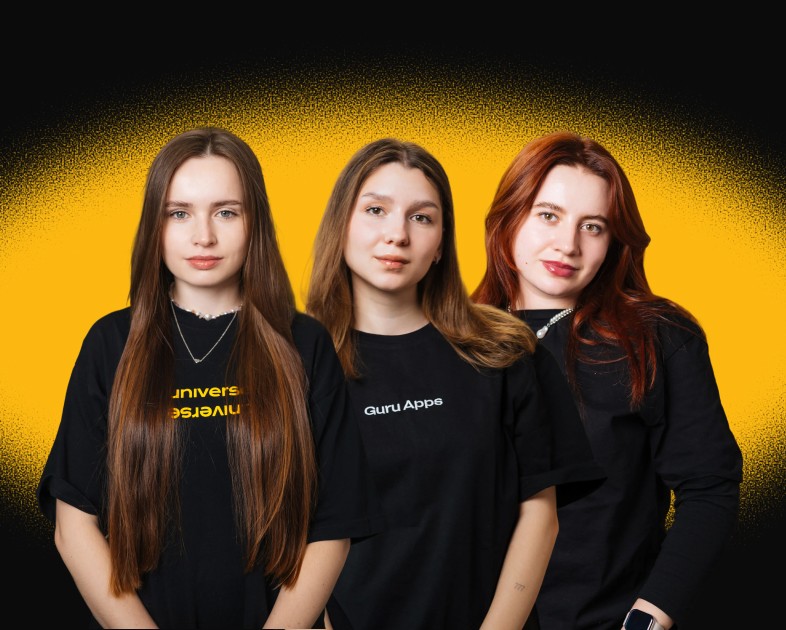
In this article, we share the stories of three participants from the first cohort of the intensive who joined the Guru Apps business team after completing the program: Liza Yarmolenko, Katia Ryskal, and Kristina Shustova. They talk about their paths, their experience during the intensive, and their transition into the team.
How the Design Intensive Worked
Product Design Intensive lasted two weeks and was built as an intensive simulation of a product designer’s work in a real business environment. Participants worked with products from Guru Apps, one of Universe Group’s businesses, and focused on tasks that directly impact key business metrics: conversion, retention, and monetization.
During the intensive, each participant worked on 5 to 10 product hypotheses aimed at improving specific stages of the user flow — from first launch to paid conversion.
The foundation of the work was research focused on measurable results. Participants conducted competitive analysis of more than 10 solutions in the niche, took part in usability testing with real users, and ran in-depth interviews. Based on this research, they formed and prioritized hypotheses according to their expected impact on metrics.
Each design decision was clearly framed around one question: which metric are we changing and why. As part of the intensive, participants also created ASO screenshots with a focus on conversion uplift, worked with the product design system, developed animations and microinteractions, and prepared design solutions for A/B testing.
The process was built around fast feedback and iterations. On average, each solution went through two to three review cycles with mentors and the product team. Feedback focused not on visuals, but on the logic of the solution, the clarity of the hypothesis, and the potential business impact. This helped participants learn how to make design decisions with limited time and data — just like in real product teams.
The final stage was a results defense, where participants presented their design solutions in a product-style format: problem → insight → hypothesis → solution → expected impact on key metrics. Each solution was supported by clear reasoning about its impact on the product. Participants answered business questions from the team and product managers who were specifically involved to critically evaluate the decisions and test product logic.
As a result of the intensive, designers with the strongest solutions and a results-driven mindset were invited to a bar-raising interview, the final selection stage. After that, they received job offers and joined Universe Group’s product teams.
Participant Stories
“Working with a real product completely changes how learning feels” — Liza Yarmolenko, Product Designer, Guru Apps

Before the intensive, Liza worked as a UX and UI designer at the Ukrainian social startup abitly.org. Her role already included many tasks related to product design: she helped improve the website design, structured it, and suggested solutions for improving existing and new user flows.
Liza learned about the intensive through a friend who worked at Universe Group and decided to apply to gain new experience, see how a large company works on real products, and develop her skills.
The two weeks of Product Design Intensive passed quickly for Liza, with a fast pace and a wide range of tasks. Every day brought something new — from analysis to solution presentations. What surprised her most, and at the same time became very valuable, was team allocation and working with a real product instead of a fictional case. Liza emphasizes that working with an existing app and knowing that your solutions can actually be implemented feels completely different.
Together with her team, Liza worked on the Cleaner Guru app. They analyzed the current state of the product, formed insights, and proposed improvements. After that, they designed solutions for A/B tests, created ASO screenshots, worked with animations, conducted research, built a hypothesis table, and presented results to designers and the product team.
“During the internship, I improved my public speaking skills, learned how to present and defend ideas, work in a design team, and better understand how hypotheses are formed and how design affects both product and business. I learned how to work with animations, conduct research, analyze results, and better understand why good-looking design is not always effective,”
— Liza shares.
After the intensive, Liza joined the Cleaner Guru team. On her second day, she took on her first task, and within the same week, she joined user research and interviews with users from the United States. Within a few months at the company, Liza worked on large in-app hypotheses, conducted multiple studies, and experienced the value of working in a design team focused on shared results.
“I hit a ceiling in outsourcing and wanted product” — Katia Ryskal, Product Designer, Guru Apps

Before the design intensive, Katia worked as a UX and UI designer in outsourcing companies. At some point, she felt a “ceiling”: design existed separately from results, and the impact on the product was limited. That’s when she decided to change her approach and move into product design.
For Katia, Product Design Intensive was very intense — and that, in her opinion, is exactly the value of the format. The intensive reflects the real pace of company work and helps participants understand whether they are ready for the speed of the product world.
What surprised Katia the most was how open people were. She admits she expected tough competition, but instead found support. The team was genuinely interested in helping participants grow, learn, and раскрыти themselves.
During the intensive, Katia worked with the Cleaner Guru app and analyzed why users delete similar apps and which features are most valuable to them. Based on these insights, Katia and her team formed a solution concept and tested a hypothesis around personalized user tips.
After finishing the program, she felt that she had become a product designer not only by role, but also by mindset. According to her, the difference between outsourcing and product work is huge: in product teams, you are responsible for results — and that gives real energy.
“In such a short time, I gained very concentrated experience in product and growth design. This is the kind of knowledge that shapes a specialist on the market. The intensive is a chance not just to find a job, but to find your place and people you want to grow with. I will mentor the next cohort myself, so I promise — it will be challenging, but worth it,”
— Katia says.
After two weeks of the intensive, Katia already knew the people, processes, office, and tasks, so onboarding took only a few days. She is now working on an app from the Guru Apps R&D center and is proud of the research and tests the team is implementing — but most of all, of her own progress.
“We dove into a real process — from hypotheses to defending solutions” — Kristina Shustova, Product Designer, Guru Apps

Before the design intensive, Kristina worked as a freelancer, took on pet projects, and had startup experience. However, she was consciously looking for the next step — transitioning into product design. She was interested in the business side of products and teamwork. Looking back, she says the intensive was exactly the environment she had been searching for.
For Kristina, the Product Design Intensive format was максимально practical. Office work, team and individual tasks, brainstorming sessions, and solution defenses created the feeling of real product work.
One unexpected and pleasant detail for Kristina was Universe Group’s approach to organization: the intensive started with welcome gifts, and the team took care of everyday details like lunches and snacks. This created a warm atmosphere throughout the day.
During the intensive, Kristina worked on the ScanGuru app. She redesigned screens, designed new flows with animations, analyzed competitors, and contributed to marketing tasks. A significant part of the work was research-related — usability testing, in-depth interviews, and hypothesis building. She also worked with the design system and created ASO screenshots for the App Store.
“During the intensive, I developed product thinking because I saw how real product work happens. I learned to think strategically instead of designing for the sake of design. The most valuable part for me was teamwork: we tried different approaches, discussed, experimented, and eventually built strong collaboration. This taught me how to listen to others and achieve results together,”
— Kristina shares.
Kristina’s transition into the team felt very natural, as she already knew the people, processes, and products. According to her, the design team she met during the intensive still supports her today. Kristina has now been working at Guru Apps for six months: first on Visify, and now on ScanGuru. She is proud of her growth, the development of her soft skills and product mindset, as well as internal team initiatives — including work with AI tools and preparing a monthly AI digest.
Product Design Intensive is a format where designers work with real products, go through the full task cycle, and understand how their decisions can impact both product and business already during the learning process. |
|---|
If you also want to transition into product design, test yourself in the real pace of a product company, and gain experience as close as possible to working in a real team — we invite you to join the second cohort of Product Design Intensive.
Details and registration:https://uni.tech/product-design-intensive?utm_source=Blog